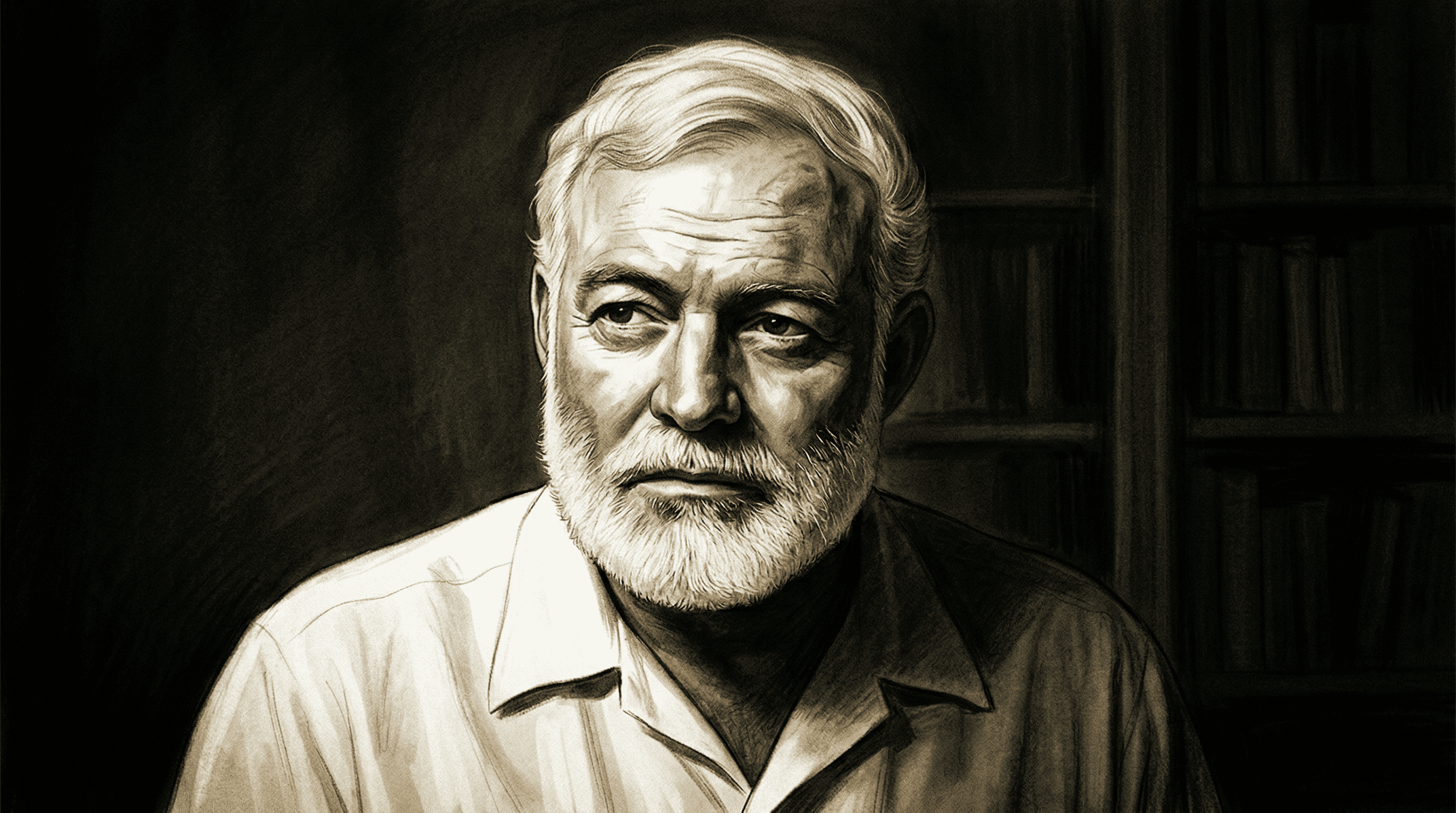
In a room on a hill overlooking Havana, on a morning in the late 1950s, a tall man in a white guayabera shirt is writing in pencil on a sheet of onion-skin paper. The paper is balanced on the top of a leather-bound Webster's dictionary, which sits on top of a bookcase that comes almost to his chest. He is writing standing up because his back will not allow him to sit for the length of a morning's work. The back is the legacy of two plane crashes in Africa in 1954, the first of which left him leaking cerebrospinal fluid from his right ear.1
He writes with a yellow Ticonderoga pencil, sharpened the night before, because he believes the slower hand forces slower thinking. On the top of the bookcase, beside the dictionary, is a homemade cardboard chart. The chart does not show temperature. It shows his daily word count, written in pencil, with a single line drawn through the number on any day he failed to reach five hundred. There are many lines.
This morning has been a good one. By half past eleven he has written six hundred and forty-two words. He caps the pencil. He writes good beneath today's number. He does not read back what he has written. The rule is never to end a session with the sentence you are struggling with — always stop with the next sentence half-formed in your head, so that tomorrow's first move is already waiting.2 He closes the Webster's. He walks out of the room.
His name is Ernest Hemingway, and the room he has just left is inside the most expensive writing architecture ever built by an American writer.
#The Finca
The room is on the second floor of a single-story Spanish colonial house called Finca Vigía — "Lookout Farm" — on seventeen hectares of land in the village of San Francisco de Paula, fifteen kilometers southeast of Havana. Hemingway bought the Finca in 1939 for $12,500 during his marriage to his second wife, Pauline Pfeiffer.3 He will live in it, intermittently but as his principal residence, for twenty-one years.
The Finca in its peak years contains the following:
A staff of nine, including a cook named René Villarreal — who Hemingway raised from childhood after finding him as an orphan on the property — two gardeners, a driver, a laundress, and, most importantly, Gregorio Fuentes, the Cuban captain of his fishing boat, the Pilar. Fuentes has worked for Hemingway for more than twenty years by the late 1950s and is, by general agreement, one of the models for Santiago in The Old Man and the Sea.4
A library of nine thousand books. A swimming pool, heated by a boiler that runs on fuel oil. Between thirty and sixty cats, depending on the year and on whether you are counting.5 A thirty-eight-foot fishing boat docked in Cojímar, which Hemingway bought in 1934 and which has fished the Gulf Stream continuously under Fuentes's command ever since.
And a Mary Welsh, who by the late 1950s has been his wife for twelve years. Before Mary there was Martha Gellhorn, and before Martha there was Pauline, and before Pauline, years earlier in a small apartment in Paris above a dance hall, there was Hadley Richardson. Each of them had been, for a time, part of the architecture.
#He did not write at the Finca
The mistake people make when they write about the Finca is to describe it as the setting of Hemingway's great Cuban-period work: For Whom the Bell Tolls, The Old Man and the Sea, A Moveable Feast, Islands in the Stream. As if it were a lovely place where a great writer happened to do his work, because he liked the view and the fishing and the cats. This is not wrong. It is insufficient.
The Finca was not where the books were written. The Finca was what made the books possible. The difference is what this series calls an Emma — after Darwin's wife, who held the entire structure of her husband's working day in place so that his failing body did not have to. An Emma is the person, the place, or the discipline that holds the architecture around the work. In Darwin's case, the Emma was a marriage — a woman who read him letters on a sofa, played him exactly two games of backgammon every night, and kept the children away from the study window for forty years. In Hemingway's case, the Emma was an estate.
Hemingway could not have written The Old Man and the Sea at a desk in a New York hotel room. We know this because he tried — many times, across many decades, to work in hotel rooms — and every attempt produced fragments, false starts, abandoned chapters. His productivity was not portable. What was portable was the talent. What was not portable was the system inside which the talent could function.
Consider the conditions the Finca provided:
Silence in the mornings. Nobody was allowed to speak to Hemingway between six and noon. Mary kept this rule with an iron hand. The cook worked in a distant kitchen. The gardeners stayed at the far end of the property until after lunch. When a guest stayed overnight, they were instructed by Mary on the precise hours during which the master of the house was not to exist.6
A standing desk he had built himself, in a specific room, with the dictionary at a specific height. Not a portable solution. A permanent installation.
Morning rituals. Coffee made the night before and drunk cold. Pencils sharpened the night before and lined up in a jar. The chart on the bookcase. A particular pair of worn moccasins. These were not affectations. They were triggers — the sequence of physical acts that told his nervous system that writing was about to begin.
The promise of afternoon release. At noon he stopped, no matter what, and the afternoon belonged to the Pilar: fishing the Gulf Stream with Fuentes for marlin and kingfish, drinking mojitos at La Floridita, swimming laps in the pool. The knowledge that the work would end at noon made the work until noon bearable. Writers who cannot stop at a fixed time write shorter lives.
A wife who ran the household. Mary did not only handle correspondence and guests. She handled the moods. Hemingway's moods in the late 1950s were immense and frequent and terrible, and they required active management — a drink brought at the right moment, a guest redirected, a bad review hidden until evening, a hospital call made without his knowledge. Mary was, by her own later admission, exhausted for the final ten years of his life. She was also the condition under which he continued to exist.7
A country. This one matters most. Cuba in the 1940s and 1950s had a particular climate, a particular cuisine, a particular pace, and a particular political neutrality that allowed an American Nobel laureate to live there without being drafted into any American cultural war. Hemingway had tried France, Spain, Key West, and Idaho. None of them held him the way Cuba did. In his later journals he was explicit: "I write best in Cuba, and I am miserable everywhere else."8
#The four wives
The marriages need to be addressed, because they are usually addressed as gossip, and gossip is easier than structural analysis. The four wives — Hadley Richardson, Pauline Pfeiffer, Martha Gellhorn, Mary Welsh — are usually presented as the romantic failures of a difficult man. This is true, as far as it goes. But it misses the pattern.
Each of the four wives was, among other things, a specific configuration of infrastructure matched to a specific phase of his work. Hadley held Paris in the twenties. Pauline held Key West in the thirties. Martha held Spain and the Civil War journalism period. Mary held Cuba — and then the collapse that came after Cuba. When a phase of work ended, the wife who was configured for that phase also ended. This is not a defense of his behavior. He was by most accounts cruel in the transitions, and the cruelty left wreckage in the lives of four women. But the pattern is not random. It is load-bearing, and when the load changed, the bearing changed.
This is the darker half of what a bought Emma looks like. Emma Darwin was held in place by a marriage that was protected by love and by the Victorian household itself. Emma Darwin was not replaceable. The wives of Ernest Hemingway were — to him — components of an infrastructure he could afford to rebuild every decade. And so he did.
#January 1959
On the first of January, 1959, Fidel Castro marched into Havana. Batista had fled the night before. Hemingway was in Ketchum, Idaho, for the winter. He would not return to the Finca until March.
He was, at first, cautiously optimistic. He had been openly contemptuous of the Batista regime's corruption, and he met Castro once — briefly, at a fishing tournament in May 1960, where Castro won a trophy for blue marlin and Hemingway presented it to him. Photographs exist. The two men are smiling. Both men know that the photograph will be used by people they do not control, for purposes they cannot predict. Both men are right.
By the summer of 1960 the political direction of revolutionary Cuba is clear. The Americans are preparing what will become the Bay of Pigs invasion. The U.S. State Department is pressuring Americans to leave. Cuban government expropriations of foreign property are accelerating.
On the twenty-fifth of July, 1960, Ernest and Mary Hemingway flew out of Havana. They brought two suitcases. They expected to return in a few months, after things stabilized.
They never returned.
The Finca was seized by the Cuban government the following year. His nine thousand books, his manuscripts in progress, his mounted kudu heads, his hand-built standing desk, his swimming pool, his cats, the Pilar, his twenty-one years of accumulated daily rituals — all of it remained on the island he could no longer enter.9
#Ketchum
In Ketchum, Idaho, in the autumn of 1960, Ernest Hemingway sat down to write a brief foreword for a Life Magazine feature on young American writers. The foreword was supposed to run a few hundred words. He worked on it for two weeks and produced three sentences. Then he worked on it for two more weeks and produced nothing further. By late October he told his editor at Scribner's that he could not finish the piece. His editor, who had worked with him for thirty years, told him not to worry about it. He worried about it every day for the remaining eight months of his life.10
In November he was flown to the Mayo Clinic in Rochester, Minnesota, for what Mary Hemingway's memoir describes as a rest cure. In fact, it was a psychiatric admission for acute paranoia, depression, and suicidal ideation. The paranoia was the most visible symptom: he believed the FBI was watching him, tapping his telephones, reading his mail, waiting to arrest him. His doctors told him this was a delusion. It was not a delusion. Declassified FBI files released in the 1980s confirm that J. Edgar Hoover had ordered active surveillance of Hemingway beginning in the 1940s, and that the surveillance intensified after his moves between the United States and revolutionary Cuba.11 Hemingway was medically treated for a delusion that was also a fact. Both things were true.
At the Mayo Clinic he received electroconvulsive therapy. The first round did not work. In the spring of 1961, after a brief return to Ketchum and at least two intercepted suicide attempts, he was readmitted. A second round of ECT was administered. After the second round, he told his friend and biographer A.E. Hotchner:
Well, what is the sense of ruining my head and erasing my memory, which is my capital, and putting me out of business?12
He was out of business, and he knew it. On the morning of the second of July, 1961, in the foyer of the Ketchum house, while Mary was asleep upstairs, he went to the gun rack, selected a Boss double-barreled shotgun, placed the barrel under his chin, and fired.
He was sixty-one years old. The Finca had been beyond his reach for eleven months and twenty-two days.
#The cost of a bought Emma
Every Hemingway biography eventually confronts the question: was it the suicide gene? His father shot himself in 1928; his brother Leicester would shoot himself in 1982; his sister Ursula would kill herself with prescription drugs in 1966; his granddaughter Margaux would kill herself with prescription drugs in 1996. The gene is real. Or was it the alcohol, the African plane crashes, the traumatic brain injuries, the liver damage, the depression? All real, all documented, all present in every year of his adult life.
But the structural question — the one that matters if you are trying to understand what makes a working life possible and what takes it away — is not about what made Hemingway vulnerable. It is about what made him functional, and for how long, and why the functioning stopped when it did. The vulnerabilities were all preexisting. They were present at Paris in 1922, at Key West in 1930, at Cuba in 1940. What changed in the last thirteen months of his life was not the vulnerabilities. What changed was the architecture that had been holding them.
A bought Emma is powerful and fragile. For thirty years the Finca produced some of the most widely read American prose of the twentieth century. It was more productive, measured in books per year, than any writing architecture Darwin ever had. It was more comfortable, measured in hectares and cats and boats, than any architecture that any of the figures in this series ever had. And then it was taken away in a single political event that Hemingway had no ability to influence, and his writing did not survive the loss by a full calendar year.
This is the cost of an Emma that exists outside you as an asset — in a place, under a government, attached to a currency, subject to politics and weather and time. Emma Darwin was outside Darwin too, but she was held in place by a marriage and by love, and she stayed until she died. The Finca was held in place by money and by Cuban stability, and both of those things turned out to be negotiable on a timeline Hemingway did not set.
#The small bought Emmas
Most of us do not have Hemingway's money. None of us will lose a seventeen-hectare Caribbean estate in a communist revolution. It would be easy to read this essay as a story about a man whose problems are too distant from our own to mean anything.
This would be a mistake. We all have tiny bought Emmas.
The coffee shop we wrote in for five years, which closed during the pandemic. The therapist we saw every Thursday for a decade, who retired. The office we commuted to, which the company traded for remote work. The desk by the window in our old apartment, which we gave up for a bigger place with worse light. The gym we went to every morning, which raised its rates. The nanny who made our mornings possible, who found a better job. The neighborhood café with the specific sound of the steam wand that made us feel, while we sat there, like a person who writes.
Every adult who has ever built their work around something external has felt a smaller version of what Hemingway felt in Ketchum. You sit down to do the thing you have been doing for years, and the thing does not come. Not because you have lost the skill. Because the room around you no longer contains what the work needs. This is not a failure of willpower. It is a consequence of what a bought Emma is. A bought Emma is rented architecture. Sooner or later the lease comes up for renewal, and you discover that the landlord is history, or capitalism, or your own aging, or the person you loved who decided to leave.
#Hold the question
We have now looked at two figures who built a life's work and were held up by architecture outside themselves. Emma Darwin was held in place by love and by Victorian marriage. The Finca Vigía was held in place by American royalties and by Cuban politics. Both worked, for a long time. Both were finite.
The next two portraits in this series will examine two more answers. Haruki Murakami tries to become his own Emma through extreme daily discipline — a 4 a.m. wake-up, a ten-kilometer run, a nine o'clock bedtime, every day for more than forty years. Maya Angelou rents hers by the hour in empty hotel rooms, stripped of all décor at her instruction, paid for out of pocket. And the final article in the series will look at a young Puerto Rican musician who inherited his Emma from the island he was born on and refuses to leave it, even now, even at the peak of a global career that would be easier almost anywhere else.
But the pattern, by the end of the fifth essay, will be the same as it is at the end of this one. Every Emma we have found so far has a vulnerability. Emma Darwin died. The Finca was seized. Murakami is aging. Angelou had to pay cash for her rooms. The Puerto Rican musician will one day face a situation that pulls him from his island. Every Emma that exists outside you can be taken from you.
The question we are building toward, through five essays and one hundred and eighty-four years of evidence, is this: Is there such a thing as an Emma you can carry with you? An Emma that does not depend on a spouse, a bank account, a monastic discipline, a hotel clerk, or a country you cannot leave. An Emma that cannot be seized in a revolution, lost in a divorce, dissolved by time.
Hold the question. We are getting close to it.
Read on: The Silence at Four in the Morning.
#References
#Footnotes
-
Baker, Carlos. (1969). Ernest Hemingway: A Life Story. New York: Charles Scribner's Sons. Chapter on the January 1954 African plane crashes, pp. 517–522. The second crash, at Murchison Falls on January 24, 1954, left Hemingway with a concussion, ruptured kidney and spleen, dislocated shoulder, first-degree burns, and a temporary cerebrospinal fluid leak from the right ear. ↩
-
Hotchner, A. E. (1966). Papa Hemingway: A Personal Memoir. New York: Random House. On the "always stop mid-sentence" rule, pp. 112–114. Hemingway repeated this advice to many younger writers, including Hotchner himself, throughout the 1950s. ↩
-
Reynolds, Michael. (1999). Hemingway: The Final Years. New York: W. W. Norton. Chapter 2. Finca Vigía purchased July 1939 for $12,500 (approximately $280,000 in 2026 dollars, adjusted for inflation). ↩
-
Brennen, Carlene Fredericka. (2006). Hemingway's Cats: An Illustrated Biography. Sarasota: Pineapple Press; and Reynolds (1999), pp. 143–147, on Gregorio Fuentes and the composition of The Old Man and the Sea. ↩
-
Hemingway, Mary Welsh. (1976). How It Was. New York: Alfred A. Knopf. p. 287: "By 1958 the cats numbered, by my count, forty-four. By Ernest's count, always higher. He knew each of them by name." ↩
-
Hemingway, Mary Welsh (1976), pp. 201–204, on the household rules during writing hours at the Finca and the instruction of overnight guests. ↩
-
Hemingway, Mary Welsh (1976), p. 490 (epilogue): "For the last ten years of his life I was, I now understand, both his wife and his nurse and his protector from himself. It was not what I had imagined marriage to be. It was more important." ↩
-
Hemingway, Ernest. Journal entry, undated (late 1950s), held at the Hemingway Collection, John F. Kennedy Presidential Library, Boston. Quoted in Reynolds (1999), p. 203. ↩
-
Reynolds (1999), pp. 298–305, on the final departure from the Finca and the subsequent seizure. The Cuban government preserved Finca Vigía as a museum beginning in 1962, and it remains open to visitors today. The books, manuscripts, and trophies on the property have never been returned. ↩
-
Hotchner (1966), pp. 277–281, on the failed Life Magazine foreword and the subsequent collapse. ↩
-
Herbert L. Strong, ed. (1983). The Federal Bureau of Investigation file on Ernest Hemingway, 122 pages, released under the Freedom of Information Act. See Reynolds (1999), pp. 320–325, for analysis. The surveillance was real. Hemingway's belief that he was being watched was medically classified as paranoid delusion at the Mayo Clinic in 1960. Both things are true. ↩
-
Hotchner (1966), p. 304. ↩