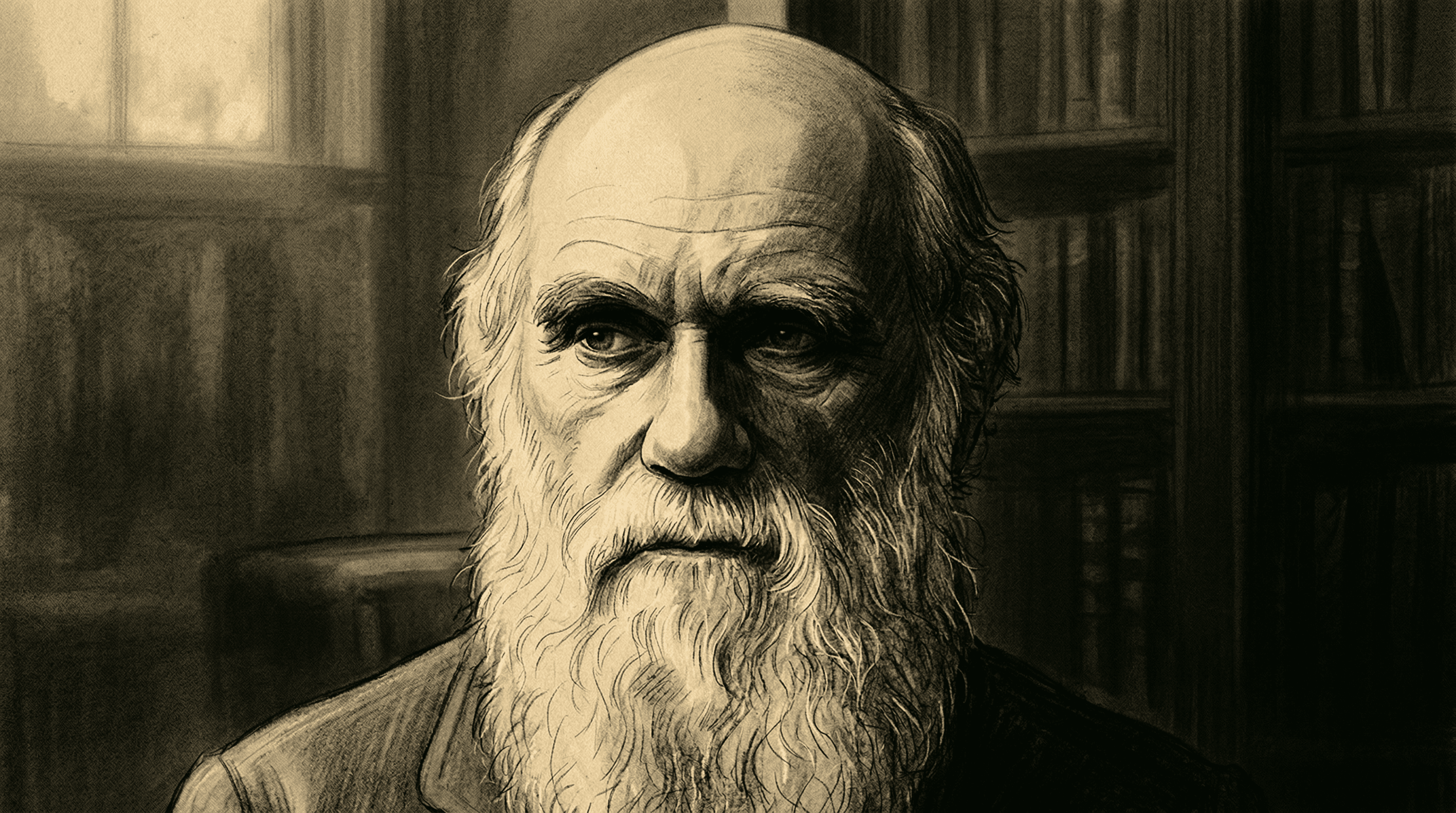
At noon, in any year between 1842 and 1882, a man in a black cloak steps out of a brick house in the village of Downe, sixteen miles southeast of London, and turns onto a path he laid down with his own hands. The path is a quarter of a mile long. It loops once through a strip of wood he planted himself — hazel, birch, alder, lime, hornbeam — and comes back to the door where it began. He walks it five times. At the far turn, where the gravel rounds the head of the loop, there is a small pile of flint stones. On each pass he kicks one aside with the toe of his boot. He does this without thinking about it. The entire purpose of the stones is that he does not have to think about them. He is thinking about something else. He is almost always thinking about something else.
His name is Charles Darwin. He is forty-three, or fifty-eight, or seventy. The year hardly matters, because the walk happens every day, for forty years, until the weeks before he dies. The desk in the study behind him is where his ideas begin. This path is where they finish — where the pieces that refuse to click at the writing table quietly find each other among the trees.
That path is the reason you have heard of him.
It is not the only reason, and it is not the usual one. The usual ones are the Beagle, the finches, the notebook he opened in 1837 and kept secret for twenty years, and the book he published in 1859 that reorganized biology. The path sounds, next to those, like biographical trivia. But the path is not trivia. The path is the infrastructure of the whole theory — the place without which the theory would not have come together, because the man who wrote it could not sit at a desk for more than ninety minutes at a stretch without his body beginning to fail him.
This is the story that every productivity book about Darwin leaves out. He did not work four and a half hours a day because he was disciplined. He worked four and a half hours a day because he was sick.
#The sickest naturalist in England
Since 1838 — the year he opened his first transmutation notebook, the year he began privately convincing himself that species were not fixed — Darwin had been unwell in a way nobody could explain. The symptoms arrived in waves and never quite left. Violent gastric attacks that left him white and shaking at the breakfast table. Heart palpitations that pinned him to the sofa for days. Shivering fits. Tremors. Headaches that put his face in his hands. Insomnia so persistent that he wrote to friends about the lost hours the way a man writes about a debt.
He saw doctor after doctor. They prescribed tonics, water cures, electric belts, and strict diets. Nothing worked for long. In the historian Fabienne Smith's survey of the whole tangled case, she observes, almost flatly, that "of all the notable Victorians who suffered from long-standing and unremitting ill health, Darwin is the best known and easily the most extreme."1
The causes proposed over the last century read like a medical detective story with an unsatisfying ending. Chagas disease, from an insect bite in Argentina during the Beagle voyage, when a triatomine bug had fed on him in the middle of the night and left him feeling strange for days.2 Lactose intolerance. Arsenic poisoning from the patent medicines of the day. Cyclical vomiting syndrome. Panic disorder brought on by two decades of holding evolutionary heresy in his head while moving in the most devout society in Europe. None of the hypotheses has been conclusively proven. His body has been gone from the earth for a century and a half, and we still do not know what was wrong with him.
What we do know is what the illness cost him, and what it forced him to do about it.
"My abominable bad health has rendered me comparatively useless for the last three years," he wrote to Joseph Hooker in one of his regular letters of apology.3 He called himself, more than once, an invalid. He wrote almost every letter from a sofa. On his worst days he could not read aloud without stopping to rest.
Now look at what this invalid produced. On the Origin of Species in 1859. The Variation of Animals and Plants under Domestication in 1868. The Descent of Man in 1871. The Expression of the Emotions in Man and Animals in 1872. Then, every two or three years until he died — orchids, climbing plants, insectivorous plants, cross-fertilization, the different forms of flowers, the movement of plants, and finally a bestseller about the quiet agricultural labors of earthworms. Fifteen substantial books across forty years, by a man who most mornings woke up sick.
The inability to work normally was not the thing Darwin overcame in order to do his life's work. It was the thing that showed him how to do his life's work. His illness taught him, decades earlier than any of his healthy peers, what the actual minimum viable working day looked like for someone doing deep creative work, and then it forced him — under threat of total breakdown — to protect that minimum for the rest of his life.
The illness was not the obstacle. The illness was the architect.
#A day at Down House
Down House is a square-fronted Georgian brick farmhouse on a narrow lane in rural Kent, twenty miles from the nearest loud thing. The Darwins moved there in 1842, when Charles was thirty-three and Emma was pregnant with their third child, and they never left. By the time the routine described below had hardened into its final form — some time in the 1850s — Darwin could predict his own day hour by hour the way a farmer can predict the arrival of the seasons.
He rose early, around seven. He took a short walk alone in the garden, whatever the weather, and ate breakfast by himself at a quarter to eight. The household still slept. He was already thinking about the day's work.
At eight o'clock he was in his study — a square room at the front of the house with a bay window overlooking the lawn, a horsehair sofa pushed against one wall, a curtained water closet in the corner for when his stomach turned against him without warning. He sat in a cane-backed chair at a low board balanced across the arms, not at the desk. He wrote with a steel pen. Around him, on shelves and in drawers and in small leather boxes labeled in his own handwriting, were the specimens and notebooks and dissecting tools of forty years of observation. He began the best work he would do that day.
This block lasted ninety minutes. Nothing more. By half past nine his body was beginning to complain, and he walked — slowly, he could walk no other way by now — out of the study and into the drawing room. He lay down on the sofa. Emma came in. She read him the morning's post aloud while he closed his eyes.
At half past ten he went back to the study for the second block. Often this was the most productive ninety minutes of the day. When it was over — usually at noon exactly, because he had been doing this for so long that his internal clock had calibrated itself to the light through the window — he set down his pen, stood up, and said, to no one in particular, "I've done a good day's work."4
Then he walked out of the house and onto the Sandwalk.
#The Sandwalk
He had built it himself, or near enough. In 1846, he rented a strip of boggy land behind the garden, had it drained, planted the trees, and laid a quarter-mile loop of gravel and sand through the wood. He called it his thinking path. For the rest of his life it was the second-most-important room in his house, and some days the first.
The Sandwalk is the kind of detail that feels invented when you first read it. It is not invented. You can walk it today — English Heritage maintains it more or less the way Darwin kept it — and see the trees, now grown tall, and the shape of the loop, and the exact spot at the far turn where he kept his pile of flints.
The pile is the part of the story that makes Darwin feel human across the century between his life and yours. He walked the loop five times, roughly — sometimes more when a problem refused to come apart — and he did not want to count the laps in his head, because counting was mental effort, and the whole point of the walk was to escape the kind of mental effort that happened at his desk. So he kept a small heap of flint stones at the turn, and on each pass he kicked one aside with his boot. When the heap was empty, he had walked his full round. His children, according to Janet Browne's account drawn from family letters, eventually figured this out and would sometimes sneak extra stones onto the pile when he wasn't looking, just to see how long they could keep him walking.5
Darwin never complained about this, as far as anyone knows. It is possible he never noticed. He was, in any given moment on the Sandwalk, not paying attention to the stones.
He was paying attention to something else. He was paying attention to what his morning at the desk had just produced, turning it slowly the way a man turns a stone in his hand, looking at it from angles he could not reach while he was still holding the pen. Some of the most important arguments in Origin of Species came together, by Darwin's own account, not at the writing table but on the gravel. The desk was where he broke problems down. The path was where they fitted back together.
A century later, neuroscientists would develop an entire vocabulary for what was happening on the Sandwalk. They would call the neural state the default mode network — the pattern of brain activity that emerges when focused analytical attention loosens its grip, and the mind begins to drift and associate and integrate without a task holding it still. They would study it in laboratories with magnetic resonance imaging and conclude that outdoor walking, particularly on familiar paths where navigation requires no thought, reliably improves creative problem-solving in ways that sitting at a desk cannot match.6 Darwin had no access to any of this research. He only knew that the ideas came on the gravel, not at the desk, and he protected the gravel as fiercely as he protected the desk.
It is the one detail of his routine that every other writer and thinker on the "morning work" pattern seems to have discovered independently. Dickens walked twelve miles through London every afternoon. Beethoven walked two hours through Vienna, carrying a pencil. Hugo walked the coast of Guernsey. Kant walked so punctually that the neighbors set their clocks by him. The path was not decoration around the work. It was part of the work.7 For the modern research on why, see our piece on Walk, Then Work.
#Emma
No honest account of Darwin's routine can skip Emma.
She was his first cousin. They had married in 1839, three years after the Beagle returned, three weeks before the first black gastric attacks began. They had ten children, of whom seven survived to adulthood. For the forty years between their move to Down House and Charles's death, Emma Darwin's day was organized, hour by hour, around his limits.
She read to him in the drawing room at half past nine while he rested his eyes. She read to him in the bedroom at three o'clock while he lay flat — novels, mostly, which he loved but could not bring himself to read himself because reading tired him too quickly. She ran the household around his work so that he would not hear the children unless he wanted to. She played piano in the evenings and kept a notebook with the running score of their nightly backgammon games — they played exactly two games a night, for decades, and Darwin tracked the tally with the obsessive precision of a man for whom this small domestic competition was the only one left. "She, poor creature, cannot endure to lose a battle," he wrote affectionately to his son.8 When he was too ill to hold a pen, she took dictation. When he needed silence, the children were kept away from the study window.
It is tempting to frame all of this in the language of Victorian gender roles, which it was, and then to leave it there, which would be wrong. The structural point is not about who cooked and who wrote. It is that Darwin's four and a half hours existed inside a household engineered, every day, to make them possible. He did not have a protected working schedule because he was disciplined. He had a protected working schedule because another person had built a world around him that made it so. Origin of Species has one author on the title page and two in the house where it was written.
Look at Emma's hours again before you move on. Exactly two backgammon games every night — not one, not three. Novels read at exactly three o'clock. The morning's post delivered on the drawing room sofa at half past nine. Always the same Sandwalk loop, never varied. Emma Darwin was not infinitely flexible. She was not a soft presence removing obstacles and handing her husband a menu of options. She was a precise, repeating architecture — a very specific set of walls that made a very specific kind of work possible.
This is the part of the Emma story that almost nobody tells. A good Emma is not a cushion. A good Emma is a wall. She protects the work by preventing certain things, not by enabling everything. She says no to what would eat the hours. She holds the door shut. She is opinionated about time, and through that opinion she makes time possible. Darwin's four and a half hours were not produced by Emma's willingness to accommodate him. They were produced by her willingness to refuse everything that would have interrupted him.
Call this what it was: the external Emma — a human partner inside the household, unpaid, loving, irreplaceable. The oldest form of the arrangement and, in some ways, the most fragile. Darwin was lucky enough to have it for forty years. Most people across history, and almost everyone reading this article, have not.
Most modern knowledge workers do not have an Emma of any kind. They sit in open offices, or in spare rooms beside a partner doing their own demanding work, or at kitchen tables between interruptions, and their environments are not engineered around their limits. The environments are engineered around everyone else's. This is one of the quiet reasons Darwin's routine is harder to replicate than it looks. Copying the hours is easy. Building the walls that protect them is nearly impossible.
#Forty years, not forty days
The hours are the part of the routine people talk about. The years are the part almost nobody talks about, and they are the more important number.
If you plot Darwin's major publications across the four decades he lived at Down House, you do not see a burst of genius followed by a long decline, which is what a lot of creative careers look like. You see something much stranger and much more valuable. You see a metronome. A book on coral reefs in 1842. Volcanic islands in 1844. Four dense volumes on barnacles between 1851 and 1854 — a project Darwin took on partly to establish his credentials as a taxonomist before publishing the evolutionary theory he had been quietly developing for a decade. Then Origin of Species in 1859. Then, at three-to-four-year intervals for the rest of his life, a new major work: orchids, domestication, descent, expression, insectivorous plants, cross-fertilization, the forms of flowers, the movement of plants. His last book, in 1881, was a surprise bestseller about earthworms. He died in April of 1882.
No sprints. No dry spells. A wave.
Four and a half hours a day, five or six days a week, fifty weeks a year, times forty years works out to something on the order of forty-five thousand hours of focused creative work. Compare that number to a single long sprint — a year of sixteen-hour days, which is the shape of life the word "grind" describes — and the sprint produces perhaps five or six thousand hours before the body breaks. Darwin's routine produced eight times that amount, spread across a life, without the body ever having to break.
This is what consistency does that intensity cannot. It compounds. It lets a body of work accumulate the way sediment accumulates — imperceptibly on any single day, inescapably across decades. Darwin chose the same hours every day. He chose them for forty years. And he stopped, without guilt, when the body said stop.
#What this means for your day
You are not Darwin. You probably don't have an undiagnosed chronic illness, and if you do, your doctor has more tools than his did. You also don't have an Emma, or a Sandwalk behind your house, or a publisher who will wait three years between books. Your constraints are different. They are real, though, and you know what they are.
The lesson from Down House is not to copy his schedule. It is to recognize the principles underneath, which are older than the 19th century and will outlast the 21st.
Work in a few short, protected blocks, not a single long one. Darwin worked three blocks of roughly ninety, ninety, and sixty minutes. Yours will look different. The shape — a small number of short sessions with real rest between them — will not.
Walk, and don't call it a break. The walk is not decoration. It is a second kind of work, the kind where the pieces that refused to click at the desk find each other among the trees. Protect it like the desk, not like a luxury.
Stop when the body says stop. Darwin stopped at noon and again at five-thirty, without apologizing to anyone and without waiting for the work to feel finished. The sentence left unfinished is not a failure. It is a deposit in tomorrow.
Design the environment around the limits, not against them. Emma was Darwin's infrastructure. Yours is software and rooms and calendars and the people you live with. Audit them honestly. What is built around your rhythm, and what is built to override it?
And count the decades, not the days. A bad day is not a failure if the rhythm holds. A good sprint is not a success if the rhythm breaks. The only question that matters, finally, is whether the pattern will still be there in a year, in five years, in forty.
The routine at Down House is often held up as a model of productive genius. It is not. It is a model of what a sick man built when his body forced him to find the smallest amount of work that would still let him do his life's work — and then to hold that small amount, faithfully, until the day he died.
Most of us will never have his constraints. That is exactly why most of us will never match his output. And almost none of us will ever have his Emma.
But Darwin is only the first of five.
Across the next hundred and eighty years, four other people built four other kinds of Emma — four other ways to hold the architecture around the work when the body is finite and the life is short. One bought his with money and a Cuban farm. One became his own through a monastic discipline that turned a novelist into a long-distance runner. One rented hers, by the hour, in stripped hotel rooms. One found his already waiting for him in the place where he was born, and refuses to leave it even when the world asks. Each of them proves, in a different register, what Emma Darwin proved in Kent: that the hours are not the scarce thing. The walls are.
The second answer is in Cuba. The man who wrote it kept his system for thirty years and then lost it in a single political event that took his house, his language for the work, and his sanity before it took his life. He is the cautionary tale of the series — the proof that an Emma built on money is a powerful Emma, and a fragile one.
Read on: What Hemingway Could Not Pack.
#References
#Footnotes
-
Smith, F. (1990). "Charles Darwin's ill health." Journal of the History of Biology, 23(3), 443-459. Smith surveys the full range of symptoms and contemporary diagnoses. ↩
-
Bernstein, R. E. (1984). "Darwin's illness: Chagas' disease resurgens." Journal of the Royal Society of Medicine, 77(7), 608-609. The Chagas hypothesis originates from the documented insect bite Darwin received in Argentina in 1835 and has never been conclusively proven. ↩
-
Darwin, C. Letter to J. D. Hooker, October 1864. Darwin Correspondence Project, University of Cambridge, letter 4635. The line about being "comparatively useless" recurs in his letters to Hooker and Lyell throughout the 1860s. ↩
-
Darwin, F. (ed.) (1887). The Life and Letters of Charles Darwin, Including an Autobiographical Chapter. London: John Murray. See especially the "Reminiscences of My Father's Everyday Life" chapter, in which Francis Darwin reconstructs the Down House routine from direct observation. The "good day's work" line at noon is one of the most quoted passages. ↩
-
Browne, J. (2002). Charles Darwin: The Power of Place. Alfred A. Knopf, pp. 473-475. Browne's second volume is essential for the texture of Darwin's daily life at Down House, including the Sandwalk and the children's mischief with the stones. ↩
-
Oppezzo, M. & Schwartz, D. L. (2014). "Give your ideas some legs: The positive effect of walking on creative thinking." Journal of Experimental Psychology: Learning, Memory, and Cognition, 40(4), 1142-1152. DOI (opens in a new tab) ↩
-
Currey, M. (2013). Daily Rituals: How Artists Work. Alfred A. Knopf. Currey's survey of 161 creative figures documents the walking-thinking pattern across centuries and disciplines. ↩
-
The Darwin-Emma backgammon scores are referenced in multiple letters. The full tally was kept in a notebook that survives in the Darwin archive at Cambridge University Library. ↩