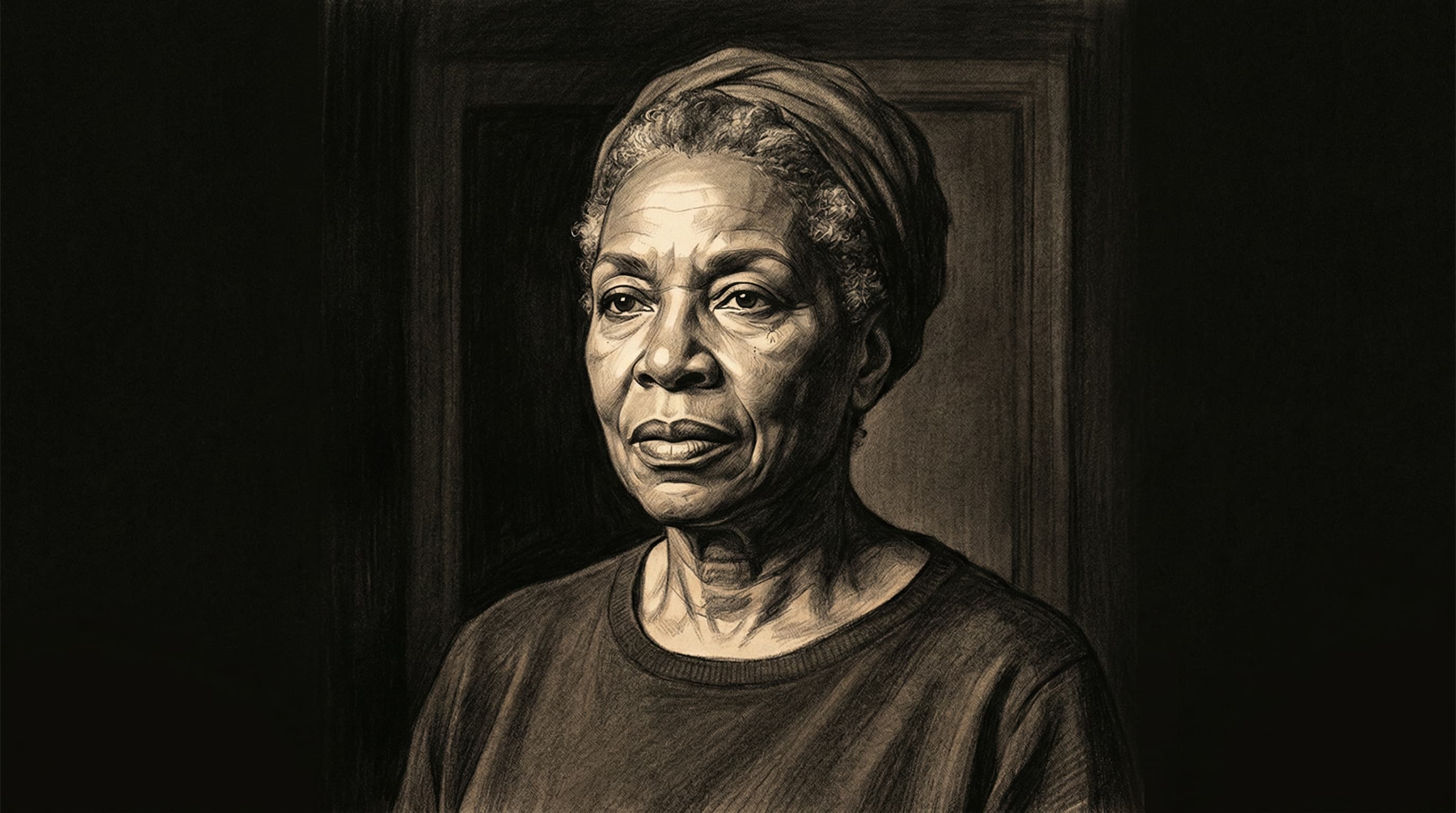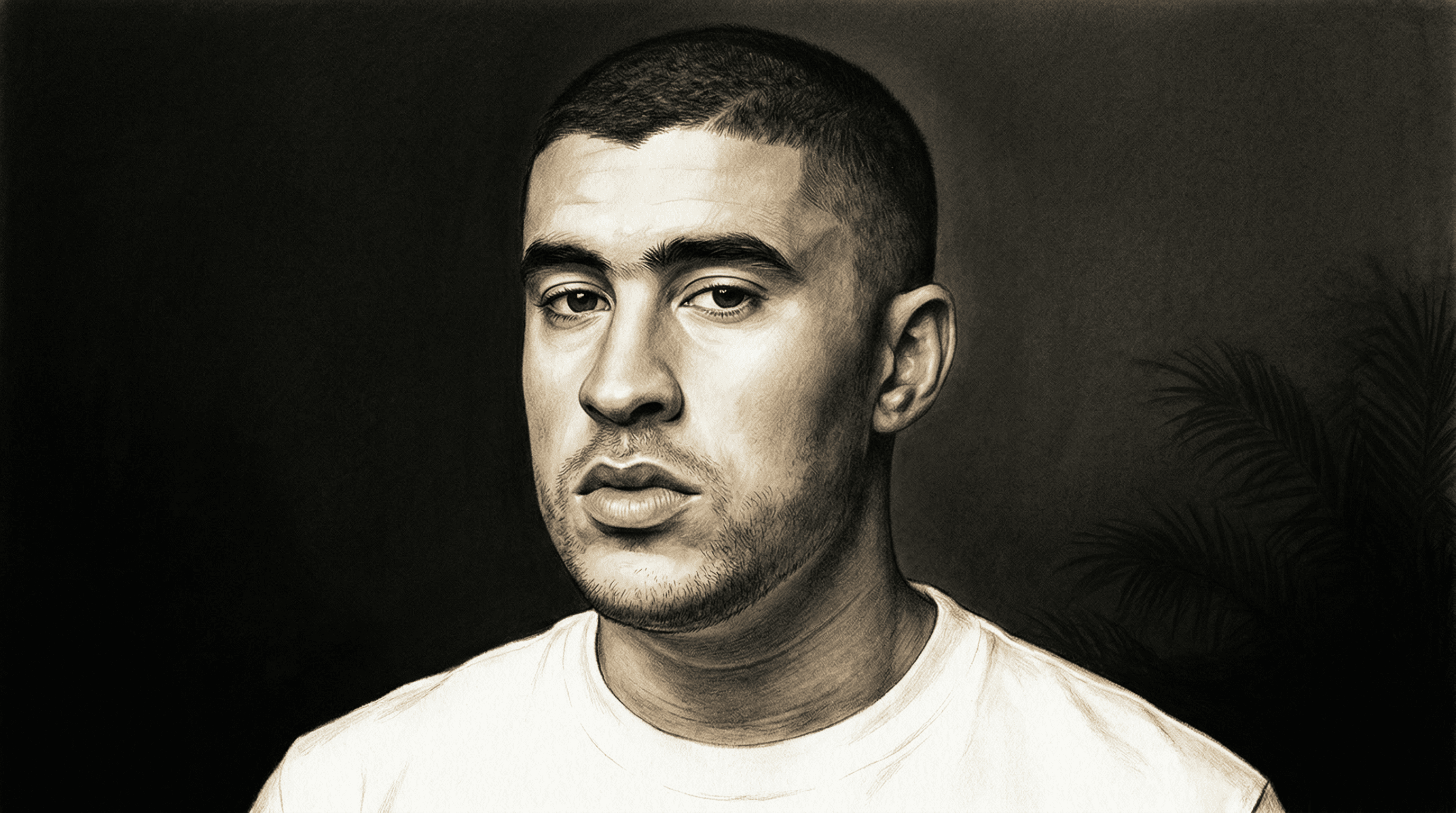
On a January evening in 2025, a man stands on a stage in San Juan and looks out at twenty thousand people who have not left their island either. The show is the thirty-seventh of a forty-date residency at the Coliseo de Puerto Rico. He could have filled stadiums in Los Angeles, Tokyo, London, São Paulo — any arena in the world, in any city, for any price. Instead he played forty nights in one building, on one island, and named the residency the thing he had been saying for a decade in every language except the one the industry wanted him to speak:
No Me Quiero Ir de Aquí.
I don't want to leave here.
His name is Bad Bunny. His legal name is Benito Antonio Martínez Ocasio. He is from Almirante Sur, a working-class barrio in Vega Baja on the northern coast of Puerto Rico — an island roughly one hundred miles long and thirty-five miles wide. He was the most-streamed artist on Spotify in 2020, 2021, 2022, and 2025. The first all-Spanish album to reach number one on the Billboard 200 was his. The first Spanish-language album to win the Grammy for Album of the Year was his. He has sold more records than any Latin artist alive.
He still lives in Puerto Rico. He records in Puerto Rico. He sings in Spanish. He has never released a solo song in English, and he never will.
"I think in Spanish, I feel in Spanish, I eat in Spanish, I sing in Spanish," he told Vanity Fair in 2023.1 The sentence is not a boast. It is a boundary — the kind of boundary that this series has been tracing across five lives and a hundred and eighty-four years.
#The supermarket
Before the Coliseo, before the Grammys, before the forty-date residency named after a refusal, there was an Econo supermarket in Vega Baja.
Benito bagged groceries part-time while studying audiovisual communications at the University of Puerto Rico at Arecibo. He wanted to be a radio host. He uploaded tracks to SoundCloud in secret — rough demos, recorded alone, shared with almost nobody. "Only a few people knew I actually made tracks," he told The FADER in 2018. "When I started freestyling, everyone liked it and it was very funny, but in private I did it for real."2
His mother, Lysaurie, taught school. His father, Tito, drove trucks. He had been an altar boy at Most Holy Trinity Parish and sang in the children's choir until he was thirteen. There was no music industry on the island — not compared to Miami, not compared to New York, not compared to Los Angeles. There were fewer studios, fewer labels, fewer meetings, fewer parties. Every structural incentive in the music business pointed away from Puerto Rico.
He stayed.
In 2016, the producer DJ Luian discovered "Diles" on SoundCloud and signed him. In December of that year, "Soy Peor" hit the Billboard Hot Latin Songs chart. He left university without finishing his degree. By 2018, his debut album X 100PRE — recorded in Vega Baja, where he had returned and shut down his social media to work — established him as the most important new voice in Latin music. By 2020, he was the most-streamed artist on the planet.
At every stage of this escalation, someone in the industry suggested he move to Miami, or to Los Angeles, or to New York. At every stage, he declined.
#The language he won't translate
The refusal to leave the island and the refusal to sing in English are the same refusal.
They are the same because they are both acts of productive constraint — walls that Benito built around his work not to limit it but to protect what makes it sound the way it sounds. His Spanish is not generic Spanish. It is Puerto Rican Spanish — the cadence, the slang, the specific way the words hit when they are sung by someone who grew up hearing them in Almirante Sur and not in a recording studio in Coral Gables. The music cannot be separated from the language because the language cannot be separated from the island, and the island cannot be separated from the man who refused to leave it.
This is what this series calls an Emma — the person, the place, or the discipline that holds the architecture around the work. Darwin's Emma was his wife, who held every hour of his day. Hemingway's was a Cuban farm he bought with royalties. Murakami's was a monastic discipline he built from scratch. Angelou's was a hotel room she rented by the month and stripped of everything that was not the work.
Bad Bunny's Emma is Puerto Rico itself.
He did not build it. He did not buy it. He did not become it. He did not rent it. He was born into it, and when success offered him every reason to leave — more studios, more collaborators, more money, more access, more of everything the industry measures — he recognized that the limitations of home were what made the work possible, and he refused to walk away.
#The fifth type
Every Emma in this series has been a form of productive constraint. Every one of them has been a wall, not a cushion — a specific architecture of refusals that made a specific kind of work possible.
Darwin's wife said no to interruptions. Hemingway's Finca said no to New York. Murakami's schedule says no to dinner parties. Angelou's bare walls said no to distraction.
Bad Bunny's island says no to the entire English-speaking music industry.
Call this the habitat Emma — the set of native constraints that you were born inside and that you recognize, at some point, as the container your work requires. You did not design these constraints. You did not optimize them. You did not choose them the way Murakami chose to wake at four or Angelou chose to strip the walls. They were already there — in the language you speak, in the neighborhood you grew up in, in the specific gravity of a place that pulls you back when you try to leave.
The habitat Emma is the hardest to see because it does not look like discipline. It does not look like architecture. It looks like stubbornness, or sentimentality, or fear of change. The industry looked at Benito and saw a man who was limiting his audience by refusing to sing in English. Benito looked at himself and saw a man who would lose his music if he translated it.
He was right. They were wrong. Four years as the most-streamed artist on earth — in a language the industry considered a ceiling — proved it.3
#The island fights back
The habitat Emma is the only one in this series that is under active political threat.
Darwin's Emma died of old age. Hemingway's Finca was taken by a revolution. Murakami's discipline may soften with age. Angelou's hotel rooms may have closed. These are natural endings — the fragility of every physical architecture.
Bad Bunny's Puerto Rico is being consumed while he watches.
In 2019, when leaked private messages revealed that Governor Ricardo Rosselló had mocked the dead of Hurricane Maria and made homophobic slurs, Benito cut short his European tour and flew home. "My people need me," he wrote on Instagram. "And I need them."4 He co-wrote "Afilando los Cuchillos" — "Sharpening the Knives" — and his verse named the governor directly: "Let all the continents know that Ricardo Rosselló is incompetent, homophobic, liar, delinquent." Rosselló resigned.
In 2022, he released "El Apagón" — "The Blackout" — attached to a twenty-three-minute documentary called Aquí Vive Gente ("People Live Here"), exposing how American investors use Act 60 tax exemptions to buy coastal property and displace the Puerto Ricans who live on it.5 The documentary, led by journalist Bianca Graulau, showed the specific mechanism by which the habitat Emma is being dismantled: not by revolution, like Hemingway's Cuba, but by capital, quietly, one beachfront lot at a time.
This is what makes the habitat Emma different from the other four. The external Emma (Darwin's wife) was held in place by love. The bought Emma (Hemingway's Finca) was held in place by money. The internal Emma (Murakami's schedule) is held in place by discipline. The rented Emma (Angelou's hotel room) was held in place by a lease. The habitat Emma is held in place by a community that continues to exist — and when that community is displaced, gentrified, priced out, or politically abandoned, the Emma dies even though the person inside it is still standing.
Benito knows this. It is why he fights. The music and the activism are not separate activities. They are both attempts to hold the walls up — the walls of a small island, one hundred miles by thirty-five, that produces the work he cannot produce anywhere else.
#100 by 35
On February 2, 2026, Bad Bunny won the Grammy for Album of the Year — the first all-Spanish album in the award's history. He stepped to the microphone and said, in English, because the audience needed to hear it in their own language:
"Puerto Rico, believe me when I tell you that we are much bigger than 100 by 35. And there is nothing we can't achieve."6
Then he added: "I want to dedicate this award to all the people who had to leave their homeland to follow their dreams."
The sentence contains the entire argument of this series. Most people leave. Most people have to. The constraints of home — the small island, the language no one else speaks, the neighborhood that pays less than the city — look, from the outside, like obstacles. Leave them behind and your audience grows. Translate your lyrics and your market doubles. Move to Los Angeles and your collaborator list triples.
But Benito's Grammy is the proof that the constraints were never obstacles. They were the architecture. The island, the language, the neighborhood, the old friends who knew him before the SoundCloud uploads — these are not the things he succeeded despite. They are the things he succeeded because of. Every limitation was a wall, and every wall was an Emma, and the Emmas held the music the way Emma Darwin held the theory of evolution: by refusing to let anything else into the room.
#The five answers
This series began with a man who walked a gravel path in Kent and ended here — with a man who stands on a stage in San Juan and says, in Spanish, that he does not want to leave.
Between them, five people built five architectures around five bodies of work:
Darwin found an external Emma in the woman who read him letters on the sofa, played him exactly two games of backgammon every night, and kept the children away from the study for forty years. His Emma was a marriage. It cost nothing and could not be purchased.
Hemingway bought his Emma — four wives, a Cuban farm, a staff of servants, a boat, and a system that worked until the politics and the marriages and the money turned against him in a single year. His Emma was an investment. It was powerful and fragile.
Murakami became his own Emma — a monastic discipline so total that his friends could not follow him into it. He wakes at four, writes for five hours, runs ten kilometers, and goes to bed at nine. His Emma is a body trained like a marathon runner's. It costs everyone who cannot keep his hours.
Angelou rented her Emma — a hotel room stripped bare, a legal pad, a Bible, a deck of cards. She could not be any of the other three. She had a son, a teaching load, a public life. She rented the absence of options, by the month, for forty-five years. Her Emma was a lease.
Bad Bunny found his Emma already waiting. It was the island where he was born, the language he spoke before he could sing, the neighborhood where his father drove trucks and his mother taught school. He did not build it. He recognized it. And when the world offered him every reason to leave, he said — in Spanish, because that is the only language his work can live inside — No me quiero ir de aquí.
#The question this series was always asking
Every figure in these five portraits had one thing in common: an architecture that held the work when the person inside it could not hold it alone. Darwin's body was failing. Hemingway's mind was under siege. Murakami's talent needed endurance it could not generate without training. Angelou's life was too full of competing demands. Benito's industry wanted him to be something he was not.
In every case, the Emma — the wife, the farm, the schedule, the bare room, the island — said no on behalf of the person doing the work. No to the interruption. No to the move. No to the translation. No to the distraction. The Emma held the wall. The person behind the wall did the work. And the work — the theory of evolution, the prose of the American century, fourteen novels in a trance, seven autobiographies written lying on a hotel bed, the most-streamed music on earth — would not have existed without the wall.
The question this series was always asking is not "How did they structure their days?" That is the surface question, the one that productivity articles answer with morning routines and word-count targets. The real question is deeper:
Who, or what, held the walls?
Most people have no one. Most people hold the walls themselves — and the walls fall, because a person who is simultaneously doing the work and holding the architecture around it cannot sustain both. The work suffers, or the walls collapse, or both.
Darwin was lucky: he had Emma. Hemingway was wealthy: he bought the Finca. Murakami was exceptional: he became his own monastery. Angelou was resourceful: she rented a room. Benito was rooted: he recognized that the island had been holding his walls since the day he was born.
But every one of these Emmas is bound to something outside the person who relies on it. Emma Darwin died eighteen years before her husband. The Finca was lost to a revolution. Murakami's body will age. Angelou's hotels could close. Benito's Puerto Rico is being gentrified, lot by lot, while he watches and fights and sings.
Every physical Emma is fragile because it is bound to a world that changes.
The question, then, is whether there could be a sixth answer — an Emma that is not a person, not a place, not a discipline, not a lease, not an island. An Emma that travels with you when the ground shifts underfoot. An Emma that holds the walls without requiring a Victorian marriage, a Cuban farm, a runner's body, a hotel bill, or a Caribbean homeland.
That is the question we built Particle to answer. Because most people will never have any of the five — and the work they carry inside them deserves an architecture too.
#References
#Footnotes
-
Bad Bunny, interviewed by Vanity Fair (2023). The full quote: "I am never going to do it just because someone says I need to do it to reach a certain audience. I think in Spanish, I feel in Spanish, I eat in Spanish, I sing in Spanish." ↩
-
Bad Bunny, interviewed by The FADER (2018). "Conejo Malo" cover story. The SoundCloud origin, the secrecy, and the transition from supermarket employee to recording artist. ↩
-
Spotify Wrapped data, 2020-2022 and 2025. Bad Bunny was the most-streamed global artist four times — more than any other artist in the platform's history. ↩
-
Bad Bunny, Instagram post, July 15, 2019, during the Ricky Renuncia protests. He cut short his European tour to return to Puerto Rico. Governor Ricardo Rosselló resigned on August 2, 2019. ↩
-
Aquí Vive Gente (2022). Documentary directed by Bianca Graulau, attached to the single "El Apagón" from Un Verano Sin Ti. Documents the displacement of Puerto Rican residents through Act 60 tax incentives for mainland American investors. ↩
-
Bad Bunny, Grammy Awards acceptance speech, February 2, 2026. Album of the Year for DeBÍ TiRAR MáS FOToS — the first all-Spanish album to win the award. Full quote: "Puerto Rico, believe me when I tell you that we are much bigger than 100 by 35. And there is nothing we can't achieve." ↩